

What makes one hyaluronic acid filler different from another? And what are the reasons for using different fillers depending on the region to be treated?
The subject is technical, but it deserves to be detailed. This way, you can better understand the specifications and indications for each of the Pharmaesthetics Biogelis fillers.® and use them in the most appropriate way.
What factors characterize fillers?
Concentration, cross-linking, elasticity, viscosity... There are some important characteristics that individualize the formulation of a hyaluronic acid filler.
Concentration is perhaps the best known of these. The more hyaluronic acid a filler contains, the more density it will offer when injected into the skin.
The degree of cross-linking, on the other hand, refers to the ability of the hyaluronic acid to form a network. This index is linked to the amount of sodium hyaluronate present in the formula - it increases as hyaluronate is added - and also to the use of a component, BDDE, which acts to promote the cross-linking process (we'll talk more about it in an upcoming article). The more the molecules are cross-linked, the more projection the filler can provide.
G Prime, rheological profile and more points that define the differences
Other terms used when evaluating the characteristics and indications of a hyaluronic acid filler are elasticity and viscosity. These, in turn, are related to expressions often mentioned when talking about this category of product: G Prime and G 2 Lines.
G Prime (or G Line) is the factor that designates the elasticity of a hyaluronic acid filler. G 2 Lines, on the other hand, is the factor that refers to its viscosity, its level of fluidity. The relationship between one and the other helps to establish how each type of filler should be used.
When, in analyses carried out by a device called a rheometer, G Prime shows a higher value and remains consistently above G 2 Lines, this shows that the main characteristic of the hyaluronic acid gel being evaluated is elasticity and indicates that it has significant power to provide volume and projection. A high G Prime also determines the filler gel's ability to resist deformation under pressure. Thus, the higher the G Prime, the less it deforms. Fillers with these characteristics are the most effective when it comes to redesigning and structuring areas that are naturally subject to greater muscular pressure, such as the jaws.
If, on the other hand, the analysis shows that G Prime and G 2 Lines start the test with equivalent values and move further apart as the evaluation progresses, the conclusion is that this is a filler with a low or intermediate degree of elasticity - and, at the same time, more fluidity. When the starting point is lower, the elasticity is lower, the viscosity higher, and the product is suitable for treating fine lines and creases in areas with greater mobility. When the starting point is intermediate, the elasticity and fluidity are equally medium and the product will bring better results when used to highlight specific areas of the face, such as the zygomas.
The tests carried out with the rheometer result in rheological profiles of the gels submitted to them - graphs that show in detail the performance of the products during the test interval. In addition to determining the G Prime and G 2 Lines - and, consequently, the level of elasticity and viscosity - they assess the degree of cohesiveness of each product, i.e. the gel's ability to maintain its consistency and uniformity even when under stress. The filler gels produced by Pharmaesthetis are recognized for their high cohesiveness.
Behind the significant results of Pharmaestetics products in rheological profile tests is a proprietary and differentiated technology. It is DNE, Dynamic Natural Effect.
Four hyaluronic acid fillers and their specific effects
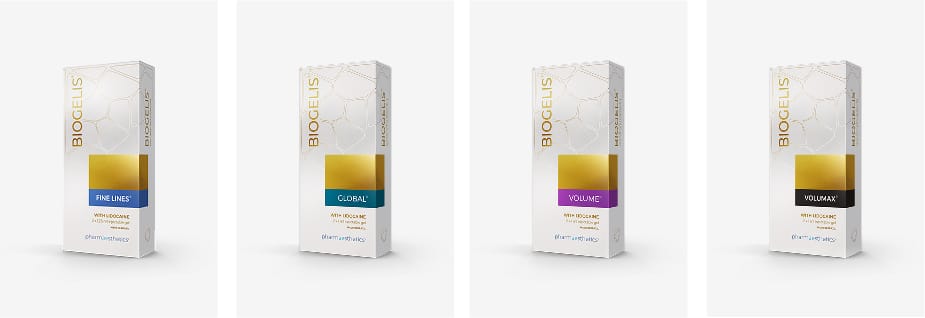
With the differentials mapped out, it's easier to understand what characterizes the four fillers in the Biogelis Pharmaesthetics line®.
Biogelis® Fine Lines is indicated for the first signs of time - nasolabial lines (popularly known as Chinese moustache) and radial lines on the face (located around the eyes and lips). It is the most fluid and least elastic version of Pharmaesthetics' hyaluronic acid fillers. It helps to even out creases, bringing more uniformity to the relief of the skin in the areas where it is applied.
Biogelis® Global has greater concentration, cross-linking and elasticity, offering a little more projection. It is the ideal filler for use in the zygoma area, restoring volume with flexibility of movement.
Biogelis® Volume is a few places higher on the concentration, reticulation and elasticity scales. It is recommended for adding volume to the chin and jaw and helps to redefine the contours of the face.
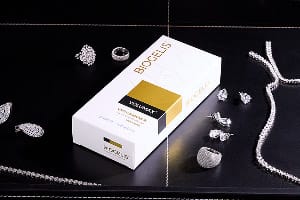
Biogelis® Volumax is the densest, most cross-linked and most elastic of all Pharmaesthetics' hyaluronic acid fillers. It is the product with the highest G Prime and the greatest projection capacity of the four varieties offered by the company. Its indications: correcting asymmetries, restoring facial contour and adding volume.
When treating a patient, the health professional must consider all these differences. Personalized, hand-crafted work, which adapts the type of filler to the targeted area and the desired goal, will bring more refined and satisfactory results.
Two final relevant observations: all products in the Biogelis family® already come with anesthetic (lidocaine) incorporated and even the denser versions have low extrusion. This last characteristic means that fillers with the Pharmaestetics signature require less force when injected, making it easier for healthcare professionals to maneuver.